
Wind Damage Roof Repair & Insurance Claims in St. Louis, MO
Straight-Line Winds · Latent Damage Assessment · Free Inspection
Storm Damage · Wind
Straight-line winds, microbursts, and the latent damage most homeowners miss
St. Louis's spring storm season produces straight-line wind events and microbursts routinely exceeding 60 mph — high enough to lift sealed shingle tabs, displace ridge caps, and create sealing failures that lead to water intrusion months before the damage becomes visible inside the home. Wind damage on residential roofs presents in two categories that require different handling: immediate visible damage — missing shingles, displaced ridge caps, lifted sections — and latent wind damage, which is far more commonly missed and more commonly the subject of disputed insurance claims. Latent wind damage occurs when shingle tabs are lifted by high wind but reseat themselves after the wind event, breaking the sealant bond without visibly displacing the shingle. The shingle looks intact from the ground, but the sealant is broken and the tab lifts freely in subsequent lower-speed winds. Over one to three seasons, this produces water infiltration at the unsealed bond line — a leak that appears to come from nowhere because the shingle is still in place. Revolve's inspections specifically test for sealant bond integrity — not just visual displacement — and document latent wind damage before it progresses to active water intrusion. Wind damage claims carry specific documentation requirements distinct from hail claims, and Revolve's inspection protocol addresses both wind uplift evidence and the documentation standard your carrier expects.
Why homeowners and businesses trust Revolve
Immediate vs latent wind damage — the critical distinction
Visible displacement is the obvious category. Latent wind damage — sealant bond failure without shingle displacement — is what most homeowners miss and most underprepared roofers do not document. Revolve tests sealant bond integrity at inspection, not just surface appearance.
Ridge cap and hip shingles — the first failure points
Ridge cap and hip shingles are the most wind-exposed elements on a residential roof. In St. Louis's frequent high-wind events, these are the first components to displace. Missing or lifted ridge caps leave the ridge vulnerable to water intrusion at every sheathing joint — a repair priority after any significant wind event.
Wind uplift and sealing failures
Wind uplift forces act on the underside of roof shingles, peeling them from the deck upward. When factory-applied sealant fails under repeated uplift, the shingle is no longer a sealed water barrier even if it remains in place. Documentation of uplift and sealant failure is the basis for a wind damage insurance claim.
What we offer
Free Wind Damage Inspection
Comprehensive inspection testing sealant bond integrity, ridge and hip condition, and flashing displacement — documented with time-stamped photos.
Latent Damage Assessment
Specific testing for unsealed shingle tabs and sealant bond failure — the damage most homeowners and underprepared inspectors miss.
Emergency Repairs
Same-day shingle replacement, ridge cap reinstallation, and tarping for active exposures after major wind events.
Wind Damage Insurance Claim Support
Documentation, adjuster meetings, and supplement preparation specifically for wind damage claims.
Full Roof Replacement
Complete tear-off and replacement when wind damage extends across a majority of the roof surface — common after microburst events.
Post-Storm Preventive Inspection
After any significant wind event in the St. Louis metro, Revolve offers free post-storm inspections to catch latent damage before it becomes active water intrusion.
Related Services
Storm Damage & Insurance Claims
Full storm damage restoration and insurance claim handling — hail, wind, and tornado.
Hail Damage Repair
Hail damage inspection, ACV vs RCV explained, supplement specialists in St. Louis.
Emergency Tarping
24/7 emergency tarping after wind and storm events — reimbursable under most policies.
St. Louis Wind Events: Straight-Line Winds, Microbursts, and Derecho Damage
St. Louis's spring and summer storm season regularly produces straight-line wind events — the downdraft-driven winds associated with severe thunderstorms — exceeding 60 mph. The June 2022 derecho event produced winds above 80 mph across St. Louis County, generating widespread roof damage across Chesterfield, Creve Coeur, Webster Groves, and Maplewood. Wind damage claims are the second most common insurance event in the St. Louis metro, after hail.
The challenge with wind damage claims — and the reason many St. Louis homeowners are undercompensated — is that wind damage does not always look dramatic from the ground. A storm that produces missing shingles and displaced ridge caps across ten percent of the roof surface will generate a prompt insurance response. But the same storm produces sealant bond failures on another forty percent of the roof that are invisible from the ground and will not produce active water intrusion for one to three seasons. By the time the leak appears, the damage is attributed to wear rather than the original wind event.
Revolve's wind damage inspections specifically test for sealant bond integrity — using a hand probe to test the adhesion of shingle tabs across the full roof surface — in addition to the visible displacement assessment. This step is what separates an accurate wind damage scope from a superficial one.
What Wind Damage Looks Like: Visible and Latent
Immediate visible wind damage: missing shingles displaced and lying in the yard or in gutters; displaced ridge cap sections, which are the highest-wind-exposure elements on the roof and typically the first to go; lifted shingle sections with tabs curling upward at the leading edge; torn or displaced roof flashings at penetrations, skylights, and chimneys.
Latent wind damage: sealant bond failure without visible displacement. This is the damage category that most homeowners — and many underprepared roofers — miss. When wind loads lift a shingle tab repeatedly without fully displacing it, the factory-applied sealant strip beneath the tab breaks. The shingle looks intact from the ground, but the tab lifts freely in subsequent wind events and water drives under it in heavy rain. The failure is visible only with a physical hand-test of the sealant bond.
Flashing damage is a third category: wind can displace counterflashing at chimneys, lift step flashing at dormers, and pull flashing away from wall assemblies at roof-to-wall transitions. This type of damage is common on St. Louis's older homes where original flashing is unsealed or installed without counterflashing, and high wind is enough to displace what was already marginally secured.
Documentation and Insurance Claims for Wind Damage
Wind damage claims carry documentation requirements distinct from hail claims. The absence of hail-characteristic circular impact marks means wind claims are supported by different evidence: creased or torn shingles at the leading edge from wind pressure, asymmetric granule displacement from wind-direction drag across the surface, sealant bond test findings, and coverage pattern of displacement consistent with the recorded wind event direction and speed.
Revolve correlates every wind damage inspection with the NOAA storm report for the event date — confirming the recorded wind speed, storm track, and event time. This correlation is used to support the claim when the insurance carrier disputes the damage as pre-existing or unrelated to a specific event.
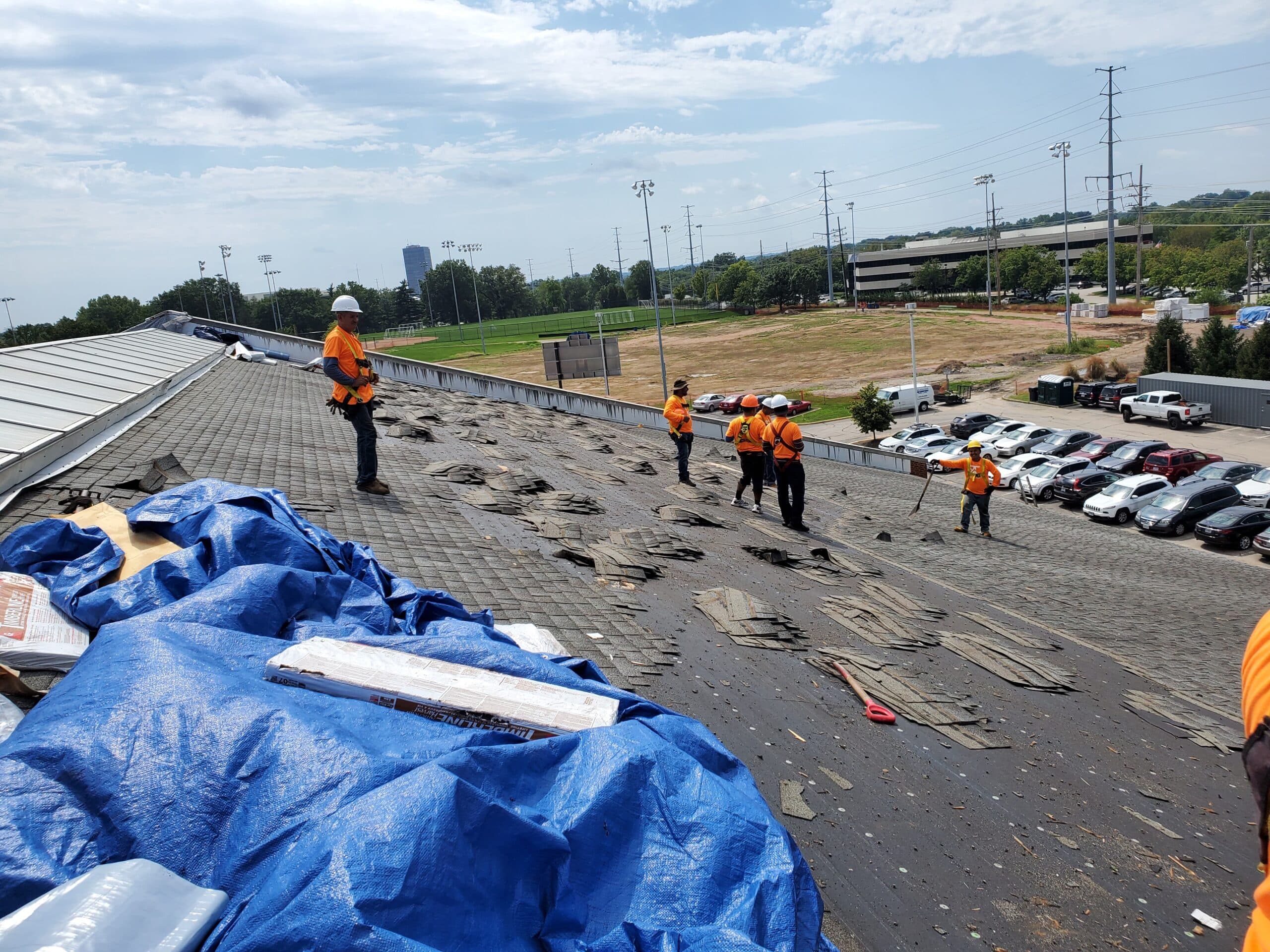
Emergency repairs — shingle replacement, ridge cap reinstallation, tarping for exposed areas — are the immediate priority after a significant wind event. Revolve responds to active wind damage situations on an emergency basis, and the emergency repair cost is documented for the insurance claim.