
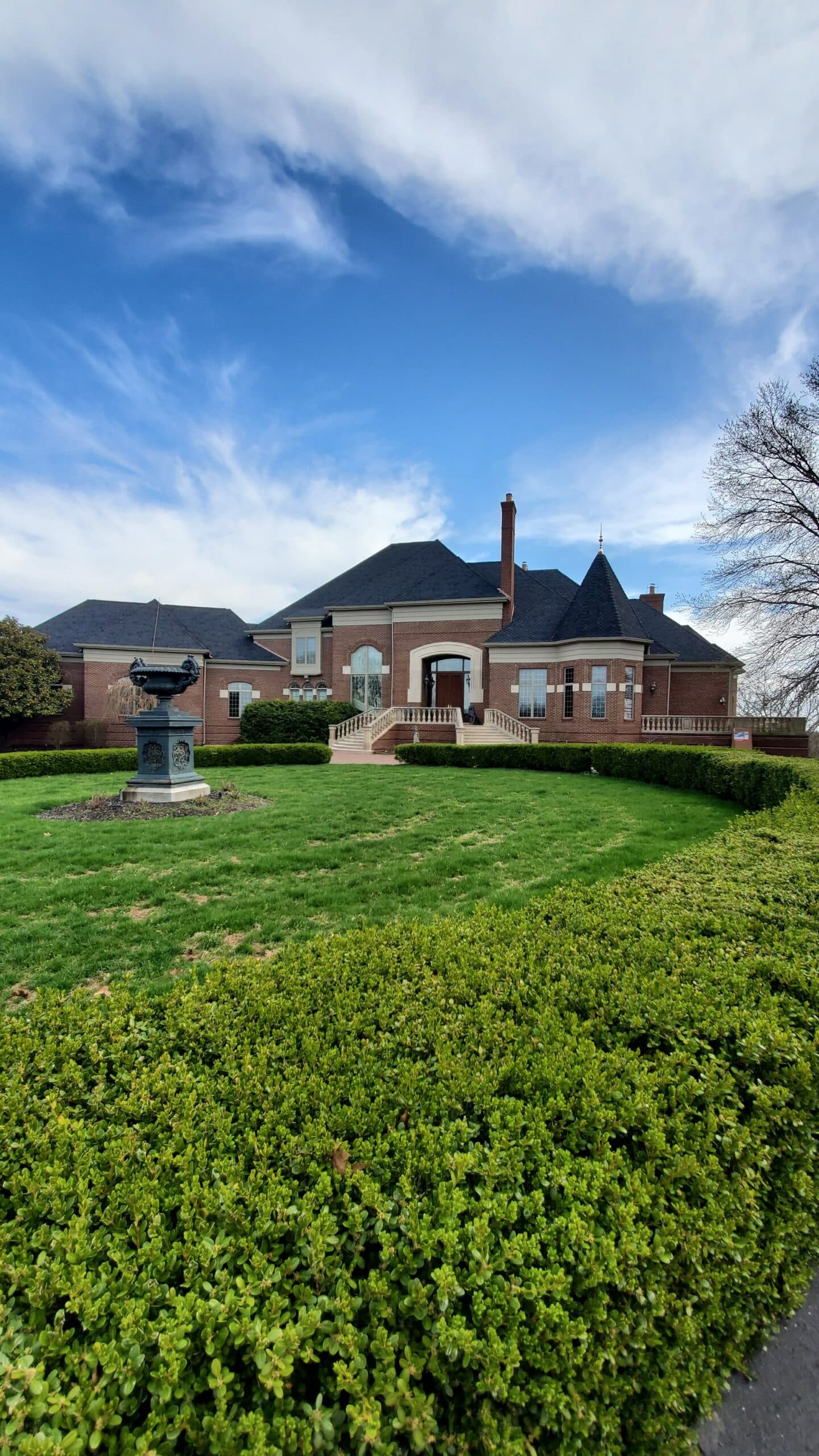
Brava Composite Roofing in St. Louis, MO
Slate · Cedar Shake · Barrel Tile · 50-Year Warranty
Residential · Brava Composite Roofing
Composite slate, cedar shake, and Spanish barrel tile — Class 4 hail rated and built for Missouri weather
Brava Roof Tile is a premium composite roofing system manufactured in Washington, Iowa from recycled polyethylene, produced in three profiles: Cedar Shake, Old World Slate, and Spanish Barrel Tile. Every Brava tile carries a Class 4 UL 2218 impact rating — the highest hail-resistance classification a roof can earn — backed by a 50-year limited, transferable warranty. That combination matters more in St. Louis than almost anywhere else. The metro sits in a documented hail corridor, and Missouri insurers reward Class 4 roofs with premium discounts that meaningfully offset Brava's upfront cost over the life of the roof. Revolve Construction is a certified Brava installer serving the St. Louis metro, and we install all three Brava lines. For homeowners in Ladue, Clayton, Frontenac, Town and Country, and Wildwood — neighborhoods where slate, shake, and Mediterranean tile aesthetics define the architecture — Brava delivers the look of natural premium materials at a fraction of the weight, with none of the maintenance cycle. Natural clay barrel tile weighs 850 to 1,200 pounds per square; Brava's barrel tile weighs roughly 255. Natural cedar requires fire and preservative treatment every few years; Brava shake requires neither. Installed pricing in St. Louis runs roughly $22 to $33 per square foot depending on profile — a genuine premium over architectural asphalt, and a defensible one for owners planning to stay in the home.
Why homeowners and businesses trust Revolve
Class 4 hail rating — built for the St. Louis hail belt
All three Brava lines carry the Class 4 UL 2218 impact rating, the highest classification available. In a metro that averages three to five significant hail events per year, that rating is a financial decision, not just a durability one: many Missouri insurers offer 10 to 30 percent premium discounts for documented Class 4 roofs.
Certified Brava installer — the warranty depends on it
Brava's warranty and wind ratings assume installation to the manufacturer's Technical Installation Manual — fastener type, headlap, hip and ridge details differ from asphalt. Revolve's crews are trained on Brava's specifications, and we provide the UL 2218 documentation your insurer needs at completion.
Three premium profiles, one warranty platform
Composite slate, cedar shake, and Spanish barrel tile — all manufactured to the same Class 4 impact rating, with Class A fire-rated options, wind resistance tested to 188 mph (211 mph with screw-down installation), and a 50-year limited transferable warranty. One manufacturer, one point of accountability.
What we offer
Brava Old World Slate
Composite slate with a one-inch profile — the thickest synthetic slate on the market — replicating quarried slate at 339 lbs per square versus 800 to 1,500 for natural stone. No structural reinforcement typically required. $24–$32.50 per square foot installed in St. Louis.
Brava Cedar Shake
Split-texture composite shake in natural wood tones. Class A fire-rated option versus Class C for untreated natural cedar — no staining, no fire treatment, no rot. Right for Craftsman, Tudor, and traditional architecture. $22–$27 per square foot installed.
Brava Spanish Barrel Tile
S-curve barrel tile for Mediterranean, Spanish Colonial, and Mission styles at roughly a quarter the weight of clay — no engineered framing upgrades. The profile with the fewest composite competitors. $27–$33 per square foot installed.
Insurance Discount Documentation
We provide Brava's Class 4 UL 2218 certification and installation photos at completion for carrier submission. Many Missouri insurers offer 10 to 30 percent premium discounts for Class 4 rated systems — ask your agent before you finalize materials.
Structural Suitability Assessment
Brava is light enough for standard framing, but we still assess deck and framing condition before specifying any product — particularly barrel tile applications on older St. Louis homes.
Design Consultation
Free in-home consultation with product samples and architectural style review. We match Brava profile and color blend to the home's architecture and the neighborhood context — and we'll tell you honestly if DaVinci or natural material is the better fit.
Related Services
Residential Roofing
Full residential roofing services including installation, repair, and storm damage.
DaVinci Synthetic Slate
Premium poly-resin composite slate and shake — Class 4 impact rated, lifetime warranty.
Cedar Shake Roofing
Natural cedar shake installation with fire treatment for St. Louis's climate.
DaVinci vs Brava Comparison
Honest head-to-head on cost, Class 4 hail performance, and warranties for St. Louis homeowners.
What Is Brava Roof Tile? The Composite Built for Hail Country
Brava Roof Tile is a composite roofing manufacturer based in Washington, Iowa, producing synthetic roof tiles from post-industrial recycled polyethylene with UV stabilizers and through-body color — the color runs through the tile rather than sitting on the surface, so hail strikes and foot scuffs don't expose a different-colored core. Three product lines cover three distinct architectural vocabularies: Cedar Shake, Old World Slate, and Spanish Barrel Tile. All three carry the Class 4 UL 2218 impact rating, are available with Class A fire-rated assemblies, and are wind-tested to 188 mph with ring-shank nails — 211 mph with screw-down installation — figures that comfortably exceed anything a St. Louis storm produces.
Brava is positioned alongside DaVinci Roofscapes at the top of the synthetic roofing market. The practical differences: Brava's tiles are made from recycled polyethylene where DaVinci uses virgin poly-resin; Brava offers a barrel tile profile that DaVinci does not; and Brava's Old World Slate is, at roughly one inch, the thickest synthetic slate profile made — a visual heft that reads as natural stone from the curb. Both are excellent products with documented performance records. Revolve installs both, presents both in consultations, and recommends based on the home's architecture, structure, and the homeowner's priorities rather than a house brand.
The Three Brava Product Lines — and Who Each One Suits
Brava Old World Slate is the flagship for St. Louis's traditional housing stock — Tudor, Colonial, and historic homes in Webster Groves, Kirkwood, Clayton, and Ladue where natural slate is the neighborhood standard. At 339 pounds per square, it installs on standard framing that could never carry the 800 to 1,500 pounds per square of quarried stone, and it installs at $24 to $32.50 per square foot in the St. Louis market — meaningfully below the $31 to $50 installed cost of natural slate, with none of the structural engineering. Roughly ten color blends replicate Vermont gray, weathered black, and mixed-tone quarry palettes.
Brava Cedar Shake suits Craftsman, bungalow, and traditional architecture — and it solves natural cedar's two structural problems in this climate. Untreated cedar carries a Class C fire rating and demands preservative and fire re-treatment on a recurring cycle to survive Missouri's freeze-thaw winters and humid summers; Brava's composite shake is non-porous, will not split, crack, or feed mold, and is available in Class A fire-rated form with zero treatment. At $22 to $27 per square foot installed in St. Louis, it is typically the most accessible entry into the Brava lineup.
Brava Spanish Barrel Tile is the line with the fewest composite competitors anywhere. Natural clay barrel tile — the roofline of Mediterranean, Spanish Colonial, and Mission architecture — weighs 850 to 1,200 pounds per square, a load most St. Louis framing cannot take without engineered reinforcement. Brava's barrel tile weighs roughly 255 pounds per square, about a quarter of clay, and installs at $27 to $33 per square foot — the highest-priced Brava line, reflecting its labor-intensive hip and ridge details. For the Mediterranean-styled homes scattered through Ladue, Town and Country, and older Frontenac, it is frequently the only structurally realistic path to an authentic tile roofline.
Class 4 Hail Rating: Why Brava Makes Financial Sense in St. Louis
St. Louis sits in a documented hail corridor — the metro averages three to five significant hail events per year, and the western suburbs from Chesterfield through St. Charles County see statistically higher frequency still. Class 4 under UL 2218 is the highest impact classification a roofing product can earn: the material must survive a two-inch steel ball dropped from twenty feet without cracking. Every tile in every Brava line carries it.
That rating converts directly into money in Missouri. Many Missouri insurers offer premium discounts of 10 to 30 percent for documented Class 4 roofs — several major carriers land in the 20 to 30 percent range on the wind/hail portion of the premium. On a premium-home policy running $2,500 to $4,000 a year, the discount is worth hundreds of dollars annually, every year, for the life of a 50-year roof. There is also a quieter benefit: a roof that shrugs off the hail event that totals the neighbors' asphalt means no claim, no deductible, and no claims-history pressure on your renewal rates.
The discount is not automatic. Carriers require the UL 2218 Class 4 certification and typically proof of installation. Revolve provides Brava's certification documentation and installation photos at project completion, packaged for carrier submission — and we recommend calling your agent to confirm your carrier's specific discount schedule before you finalize material selection.
What a Brava Roof Costs in St. Louis
Installed Brava pricing in the St. Louis metro runs roughly $22 to $33 per square foot depending on the line: Cedar Shake at $22 to $27, Old World Slate at $24 to $32.50, and Spanish Barrel Tile at $27 to $33. On a typical 2,000-square-foot roof, that puts most Brava projects between about $44,000 and $66,000 installed — including tear-off, synthetic underlayment, ice-and-water shield, and flashing work. Smaller roofs can come in near $35,000; large, steep, or complex roofs in the barrel tile line can exceed $90,000.
What moves a project within that range: roof complexity (hips, valleys, dormers, and turrets slow production and raise waste), pitch (steep-slope premiums apply above 7:12), the profile selected, and accessory metalwork — copper valleys and custom flashings are common requests on homes at this level. Brava is roughly three times architectural asphalt upfront and prices in the same band as DaVinci, which typically bids a dollar to three per square foot lower in this market; the counterweights are a 50-year service life that spans two full asphalt replacement cycles, the insurance discount, and zero maintenance spend. For the full cost breakdown with whole-house examples and material comparisons, see our Brava cost guide for St. Louis. Financing is available through our lending partners for qualified homeowners.
Brava vs. Natural Cedar and Natural Slate: The Durability Math
Against natural cedar: cedar in St. Louis's freeze-thaw climate has a realistic service life of 20 to 30 years — and only with a maintenance program of periodic cleaning, preservative treatment, and fire-retardant re-treatment that adds real cost across the ownership period. Brava Cedar Shake is rated for 50 years, holds its color without the patchy silvering of neglected cedar, cannot rot or split, and needs nothing beyond an occasional inspection and debris clearing. Cedar's one irreducible advantage is that it is real wood; from the street, on a correctly blended Brava installation, few people can tell.
Against natural slate: quarried slate is the only material that outlasts Brava — 75 to 150 years — but at $31 to $50 per square foot installed, with structural engineering requirements on most homes not originally framed for it, and with a shrinking pool of qualified slate craftsmen. Individual slates crack under foot traffic and large hail; a Class 4 composite does not. For homes that already carry natural slate, Revolve repairs and preserves it. For homes that want the look without the loading, Brava Old World Slate is the honest alternative — and we will tell you plainly which situation yours is.
Warranty and Installation: Why the Installer Matters
Brava backs all three lines with a 50-year limited warranty — currently written as a limited lifetime warranty in which 'lifetime' is defined as 50 years from purchase — covering manufacturing defects that materially affect performance. It is transferable once to a subsequent homeowner (a $100 transfer fee applies, filed within 30 days of sale), which matters for resale on a roof designed to outlast the average ownership tenure several times over. Read the terms before you buy any premium roof: like every synthetic warranty, Brava's covers the material, prorates after the first decade, and does not turn a bad installation into a good one.
That last point is the argument for installer selection. Composite tile is not asphalt: fastener type and drive depth, headlap and exposure settings, hip and ridge details — particularly on barrel tile — and valley metal integration all follow Brava's Technical Installation Manual, and deviations are the root cause of most synthetic roof failures we inspect. Revolve is a certified Brava installer; our crews are trained to the manual, and a typical Brava installation on a St. Louis home runs one to two weeks from tear-off to final magnet sweep. Deck condition, structural suitability, and ventilation are all assessed at the free pre-installation consultation.