
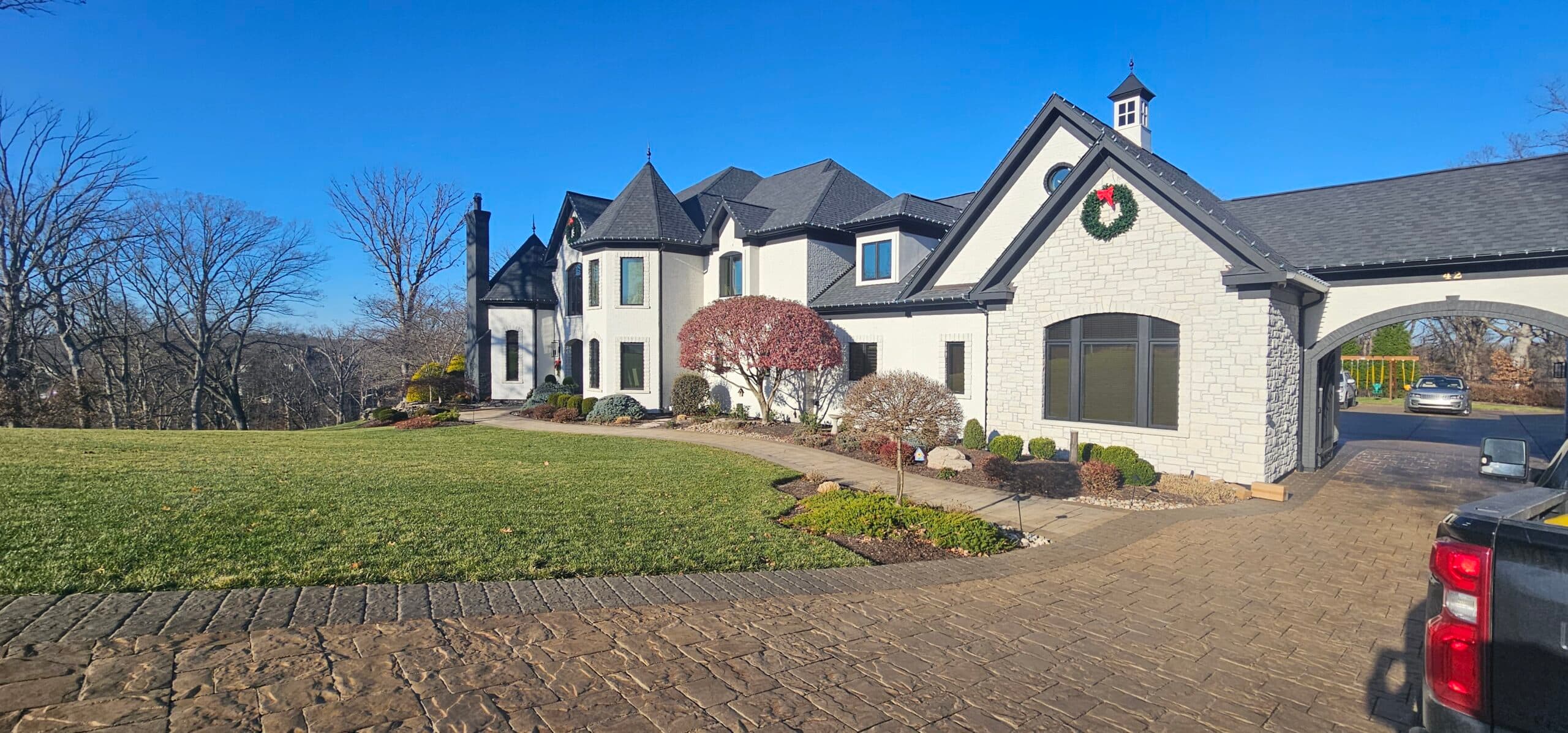
Fiber Cement Siding in St. Louis, MO
Class A Fire Rated · Hail Resistant · Rot Proof
Siding · Fiber Cement
Class A fire-rated, hail-resistant, rot-proof — the durable case for fiber cement
Fiber cement siding is a mineral composite of Portland cement, ground sand, and cellulose fiber — a material that contains no wood, no vinyl, and no organic content that decays, insects eat, or hail cracks the way it does competing materials. The result is a siding category with a Class A fire rating across all products, meaningful hail impact resistance, and a dimensional stability in temperature extremes that vinyl and wood siding cannot match. St. Louis's climate makes a compelling case for fiber cement: 95-degree summers followed by single-digit winter days create the wide temperature swing that causes vinyl to expand and contract dramatically, that checks and splits natural wood, and that degrades many siding materials ahead of their rated service life. Fiber cement handles that temperature range without the dimensional movement problems of competing materials. James Hardie is the dominant fiber cement brand in the St. Louis market — and Revolve is a James Hardie Preferred installer for that product. This page is for homeowners evaluating the fiber cement category broadly, comparing it against vinyl and engineered wood, or researching fiber cement options from manufacturers other than James Hardie. The fundamentals of fiber cement installation — correct nail placement, clearances from grade and roofline, end-cut sealing, joint sealant requirements — apply across all fiber cement products and are where Revolve's certified installation training provides real value. For James Hardie specific product details, ColorPlus technology, and Hardie product-line breakdowns, see our dedicated James Hardie page.
Why homeowners and businesses trust Revolve
Class A fire rating across the category
Every fiber cement siding product carries a Class A fire rating — the highest available classification. In St. Louis neighborhoods where homes are close together and fire spread risk is real, the fiber cement fire rating is a material safety and insurance consideration.
No organic content — nothing to rot, decay, or attract insects
Portland cement, sand, and cellulose fiber processed under heat and pressure produces a material with no organic wood content left to decay. Fiber cement does not rot at grade-level contact, does not attract wood-boring insects, and does not swell with moisture the way natural wood does.
Dimensional stability in St. Louis's temperature extremes
Fiber cement's thermal expansion coefficient is less than vinyl's by an order of magnitude. On a south-facing wall in St. Louis, that dimensional stability means siding joints stay tight, caulk seals stay intact, and the siding system performs as installed across decades of service.
What we offer
Fiber Cement Lap Siding
Horizontal lap siding in 6-inch and 8.25-inch exposures from leading manufacturers. Wood-grain and smooth profiles for traditional and contemporary architectural styles.
Fiber Cement Panel Siding
4x8 and 4x9 panel siding for board-and-batten and vertical siding applications. Contemporary aesthetic and modern farmhouse styles.
James Hardie Products
Hardie is our primary fiber cement line — HardiePlank, HardieShingle, HardiePanel, and HardieTrim with ColorPlus factory finish technology. See our James Hardie page for full product details.
Fiber Cement Trim & Soffit
Coordinated trim boards and soffit panels in fiber cement — using fiber cement trim with fiber cement siding maintains material compatibility and eliminates the differential movement problem at trim-siding interfaces.
Full Tear-Off & Installation
We remove existing siding, repair sheathing, install housewrap with proper flashing, and install fiber cement to manufacturer specification — end-cut sealing, nailing pattern, and clearance requirements included.
Storm Damage Assessment
Fiber cement damaged by hail or impact is assessed for replacement. Documentation provided for insurance claims where applicable.
The Fiber Cement Case: Why the Material Properties Matter in St. Louis
Fiber cement's dominance in the St. Louis premium siding market is driven by a specific set of material properties that match this climate's demands. Portland cement, ground sand, and cellulose fiber processed under heat and pressure produce a composite that is dimensionally stable across temperature extremes, contains no organic content that decays or insects colonize, is Class A fire-rated without any treatment, and resists the impact loads that St. Louis hail events produce. These are not marketing talking points — they are measurable material properties that explain the product's market position.
Dimensional stability is the most underappreciated fiber cement advantage in St. Louis. Vinyl siding on a south-facing wall in this market cycles through 150-degree Fahrenheit temperature ranges between January nights and July afternoons. That cycling drives the expansion and contraction that buckles vinyl and checks natural wood. Fiber cement's thermal expansion coefficient is approximately 2 to 3 millionths of an inch per inch per degree Fahrenheit — roughly one-tenth of vinyl's coefficient. On a 12-foot siding run, that difference is a factor of 10 in total dimensional movement between the two materials across St. Louis's seasonal temperature range. The caulk joints stay tight, the nail-hem holds, and the panel edges do not telegraph the substrate joints.
The Class A fire rating of fiber cement — achieved without any treatment or maintenance — is relevant to the specific built environment of St. Louis. Many of the city's residential neighborhoods were developed in the late 19th and early 20th century at densities where homes are 10 to 20 feet apart. In a neighborhood fire event, the Class A rating on exterior siding materials is a genuine factor in fire spread resistance.
Fiber Cement Product Lines in the St. Louis Market
James Hardie is the dominant fiber cement manufacturer in the US residential market and in the St. Louis metro specifically. HardiePlank lap siding, HardieShingle, HardiePanel, and HardieTrim cover the full exterior envelope in a coordinated fiber cement system, and the ColorPlus factory-finish technology — a factory-applied, multi-coat finish baked on the panels — eliminates the field painting requirement that all other fiber cement products require. Revolve is a James Hardie Preferred Installer; for complete Hardie product details, ColorPlus color options, and Hardie-specific warranty information, see our dedicated James Hardie siding page.
Other fiber cement manufacturers with significant market presence include Nichiha (a Japanese manufacturer with a strong US distribution network, known for large-format architectural panels and factory-finished wood and stone looks), Allura (formerly Cemplank, a US manufacturer competing with Hardie on price), and Ply Gem (which markets fiber cement under the Hardie private-label program in some channels). For homeowners whose project requires large-format architectural panel looks or specific non-Hardie aesthetics, Nichiha's product line offers options that Hardie does not.
Regardless of the fiber cement manufacturer, the installation requirements are consistent: proper nail type and spacing, clearance from grade and roofline, end-cut sealing, joint sealant at all butt joints, and a compatible finish coat. These requirements exist because fiber cement is a cement-based product — it will absorb moisture at unprotected cut ends and unsealend joints if installation requirements are not followed.
Fiber Cement vs. Vinyl: When Each Makes Sense for St. Louis Homeowners
Vinyl is cheaper upfront, requires no finish maintenance, and is appropriate for short-term ownership or budget-constrained situations. Fiber cement costs more upfront, requires a finish maintenance cycle (repainting every 8 to 15 years depending on product and color), and is appropriate when the homeowner plans to stay in the home and wants better performance in hail, fire rating, and long-term aesthetics.
The break-even analysis on a typical St. Louis home is approximately 10 to 15 years. Within that window, vinyl's lower initial cost and zero finish maintenance give it a total cost advantage. Beyond 15 years, fiber cement's longer service life, eliminated vinyl replacement cycle, and better hail resistance performance begin to close and then reverse the cost advantage.
For homeowners who are preparing a home for sale, vinyl siding offers a competitive market appearance at a lower investment. For homeowners who have been in their home for 20 years and plan to stay another 20, fiber cement's performance and aesthetics argument is compelling. Neither answer is universally correct — the right answer depends on the specific homeowner's situation, and Revolve presents both clearly at the consultation.
Installation Quality: What Separates a Fiber Cement Installation That Lasts
Fiber cement installation quality issues are less visible than vinyl's buckling problem, but they are more consequential. Exposed cut ends — fiber cement sawn without end seal applied — absorb moisture at the sawn edge and produce swelling, paint adhesion failure, and eventually material delamination. The failure begins at the cut end, is typically concealed behind trim for the first few years, and becomes visible as the trim condition deteriorates.
Revolve end-seals every field cut on every fiber cement installation using manufacturer-specified end-cut sealant. This is non-negotiable. We also apply joint sealant at every butt joint, at every window and door transition, and at every penetration. The caulk is a maintenance item — it needs inspection and replacement on a 7 to 10-year cycle as part of normal fiber cement siding maintenance — and Revolve explains this maintenance responsibility clearly at project closeout so homeowners understand the long-term care program for their investment.