
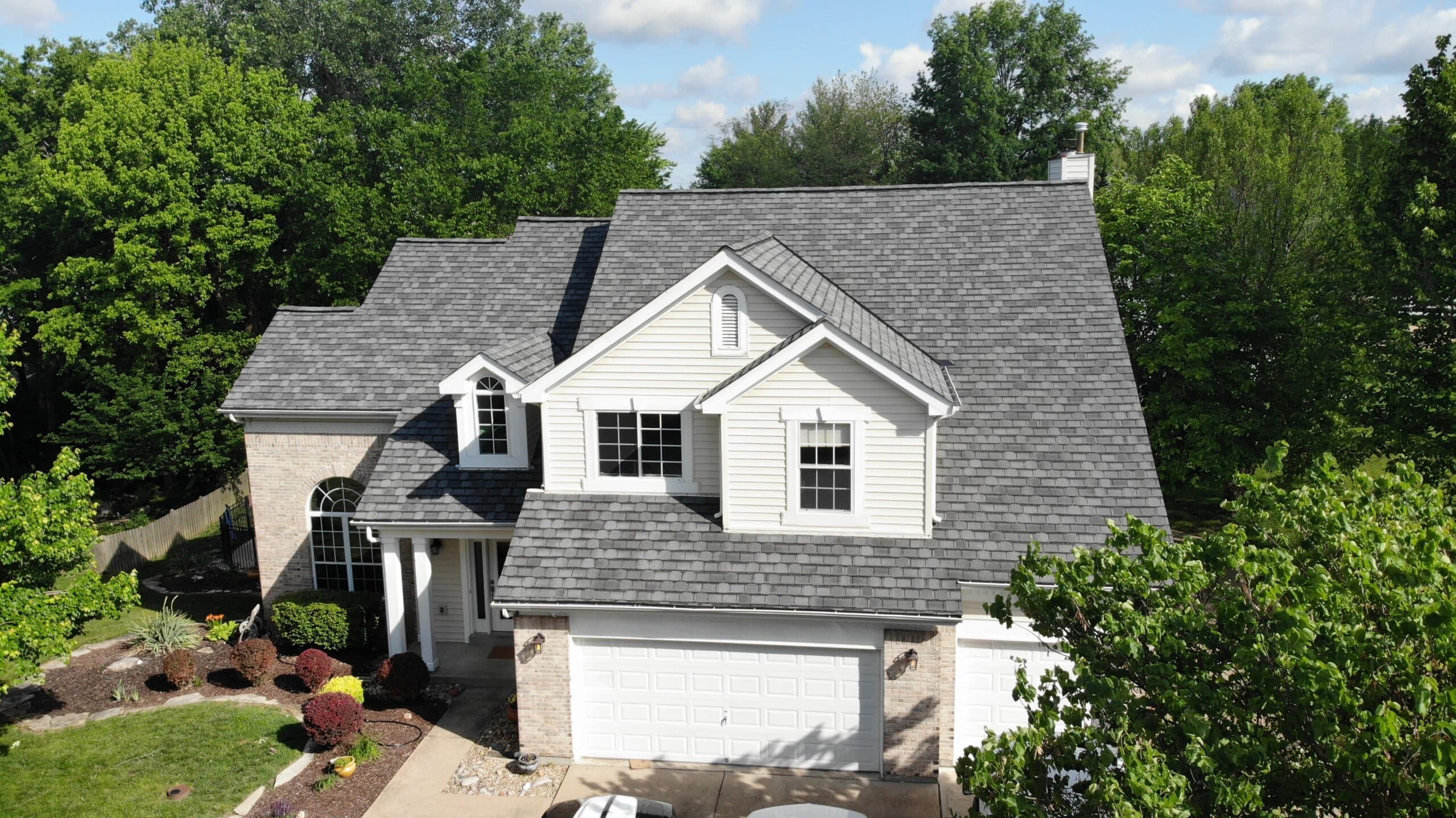
Cedar Shake vs Synthetic Slate Roofing
Honest Lifespan, Cost & Maintenance Comparison · DaVinci · Brava · St. Louis
Residential Roofing · Material Comparison
Natural wood character vs engineered longevity — the honest comparison
Cedar shake and synthetic slate roofing serve the same aesthetic goal — a high-character, premium-looking roof that stands out from standard architectural shingles — but they arrive at that goal through fundamentally different paths. Natural cedar shake is exactly that: hand-split or sawn western red cedar, installed as individual pieces, delivering genuine wood grain and natural variation that no manufactured product fully replicates. Synthetic slate — led by DaVinci Roofscapes and Brava Composite — is engineered polymer composite designed to mimic the look of natural slate and cedar at a fraction of the weight, with 50-year warranties and Class A fire ratings that natural cedar base product cannot match. The choice between them is not obvious. Cedar advocates are correct that nothing looks quite like the real thing, especially as it weathers and develops its natural silver-gray patina. Synthetic advocates are correct that 50-year warranties, Class A fire resistance, and zero maintenance requirements are genuinely better performance specifications. The right answer depends on your priorities: authenticity and natural character versus durability and performance engineering. Revolve Construction installs both. This comparison gives you the facts you need to decide.
Why homeowners and businesses trust Revolve
Lifespan: 20-30 years cedar versus 50 years synthetic
Properly installed and maintained natural cedar shake lasts 20 to 30 years in the St. Louis climate — assuming active maintenance. Synthetic composite products from DaVinci and Brava carry 50-year warranties. The lifespan gap is real and significant for homeowners who do not plan to replace the roof again.
Fire rating: Class C base versus Class A standard
Natural cedar shake carries a Class C fire rating at base — it can be treated to Class A, but treated products add cost and some treatments degrade over time. DaVinci and Brava products are Class A fire rated as manufactured, with no treatment required or degradable. For homes in wildfire-adjacent areas or with specific insurer requirements, Class A as standard is a meaningful distinction.
Maintenance: the real cost of cedar over its lifespan
Cedar shake requires cleaning to prevent moss and algae, periodic recoating or preservative treatment, and individual shake replacement as the material ages. Synthetic composite is maintenance-free after installation — no cleaning requirements, no preservative treatments, no individual unit replacement before the warranty period ends.
What we offer
Natural Cedar Shake Installation
Hand-split and resawn western red cedar installed by Revolve crews familiar with correct underlayment, spacing, and weather-barrier integration for the St. Louis climate.
DaVinci Synthetic Slate & Shake
DaVinci Roofscapes polymer composite — Class A fire rated, 50-year warranty, Class 4 impact option. The most widely specified premium synthetic in the Midwest market.
Brava Composite Roofing
Brava Old World Slate and Cedar Shake profiles — 50-year warranty, Class A fire, Class 4 impact available. Manufactured from 95% recycled content.
Free Material Comparison Consultation
Side-by-side comparison of actual product samples, cost estimates for your specific roof, and an honest recommendation based on your priorities and budget.
Insurance Claim Coordination
If storm damage is the trigger, Revolve documents damage and coordinates with your insurer for material upgrade to synthetic when the claim involves a qualifying event.
Financing Available
Premium material upgrades are available through Revolve's flexible financing options — promotional 0% plans and fixed-rate options for qualified homeowners.
Related Services
Cedar Shake Roofing
Natural cedar shake installation in St. Louis — fire-treated, climate-appropriate specification.
DaVinci Synthetic Slate
DaVinci Roofscapes polymer composite — Class 4 impact, 50-year warranty, Class A fire.
Brava Composite Roofing
Brava synthetic slate and shake — 50-year warranty, 95% recycled content, Class A fire.
Natural Cedar Shake: Authentic Character and the Real Maintenance Commitment
Natural cedar shake is hand-split or sawn western red cedar installed as individual pieces on a residential roof. The authentic wood grain, natural color variation, and gradual silver-gray weathering it produces over its lifespan are visual qualities that no manufactured product fully replicates at close range. For homeowners who are specifically motivated by the genuine material quality — for a historic home, a wooded setting, or a personal preference for natural materials — cedar shake delivers something authentic that polymer composite does not.
The cost range for natural cedar shake installation in the St. Louis market runs $14 to $22 per installed square foot, depending on shake grade (hand-split and resawn versus tapersawn), pitch, and project complexity. This positions cedar as a premium material — more expensive than architectural asphalt shingles but roughly comparable to the lower range of synthetic slate products. The initial cost comparison, however, is not the full story.
Cedar shake in the St. Louis climate realistically lasts 20 to 30 years with active maintenance. That maintenance is not passive: cedar shake requires cleaning to prevent moss and lichen accumulation — both common in Missouri's humid summers — periodic preservative or flame-retardant treatment as applied coatings age, and individual shake replacement as the material ages and individual pieces crack, cup, or delaminate. A properly maintained cedar roof represents a meaningful annual time and cost commitment that synthetic products do not.
Fire resistance is the most important specification difference between cedar and synthetic. Natural cedar base product carries a Class C fire rating — the lowest class. Class C means resistance to light fire exposure. Cedar can be treated to achieve Class A, but treated products cost more and require retreatment as the treatment compounds age. DaVinci and Brava synthetic products are Class A fire rated as manufactured — no treatment required, no degrading fire-resistance over time.
Synthetic Slate and Shake: DaVinci and Brava Compared
DaVinci Roofscapes and Brava Roof Tile are the two leading synthetic composite roofing manufacturers in the premium market. Both produce polymer composite products that mimic natural slate and cedar shake. Both carry 50-year warranties, Class A fire ratings, and Class 4 UL 2218 impact resistance. Both weigh approximately 50 percent less than natural slate, making them compatible with standard residential roof framing without structural reinforcement.
DaVinci's Bellaforte Slate and Bellaforte Shake lines are the most widely specified premium synthetic products in the Midwest market. DaVinci products are manufactured from 100 percent virgin polymer with UV stabilizers and color pigments blended throughout the material — not surface-applied — which means the color does not fade as the surface weathers. DaVinci Shake profiles produce a highly convincing natural wood aesthetic from the street and at close range, with natural variation in each panel that avoids the repetitive pattern visible in lower-quality synthetics.
Brava Roof Tile manufactures its products from 95 percent recycled content — a genuine sustainability credential for homeowners for whom recycled material sourcing matters. Brava's Old World Slate and Cedar Shake profiles carry the same 50-year warranty and Class 4 impact ratings as DaVinci. The visual result is competitive with DaVinci at a price point that typically runs $1 to $3 per square foot less installed. The installed cost range for synthetic slate and shake in the St. Louis market runs $18 to $26 per square foot.
The 50-year warranty on both DaVinci and Brava covers the material against manufacturing defects, color fade beyond defined tolerances, and functional failure for half a century. This warranty period exceeds cedar shake's realistic lifespan by 20 to 30 years — and unlike cedar, achieving the synthetic product's warranty life requires zero ongoing maintenance.
Side-by-Side Comparison: Lifespan, Cost, Maintenance, Fire Rating
Lifespan comparison: Natural cedar shake in the St. Louis climate lasts 20 to 30 years with active maintenance. Synthetic composite products from DaVinci and Brava carry 50-year warranties. The realistic expectation for a maintained cedar roof is one replacement over a 50-year homeownership horizon; a synthetic product installed today covers the same 50-year period without replacement.
Cost comparison: Natural cedar shake installed runs $14 to $22 per square foot. Synthetic slate and shake installed runs $18 to $26 per square foot. Cedar appears less expensive on initial installation, but the full 50-year cost of cedar includes one replacement (at future cost) plus ongoing maintenance. Synthetic's higher upfront cost is the only cost over the warranty period — making the lifetime economics of synthetic competitive with or better than cedar when fully modeled.
Maintenance comparison: Natural cedar requires annual inspection, moss and lichen treatment as needed, preservative application every 5 to 7 years, and individual shake replacement as pieces fail. Synthetic composite requires no maintenance beyond a post-storm visual inspection. The maintenance burden of cedar is real and ongoing; it is not captured in the installation cost.
Fire rating: Cedar base product is Class C. Treated cedar can reach Class A but requires retreatment. Synthetic DaVinci and Brava products are Class A as manufactured — permanent, no treatment required. For any homeowner with specific insurer requirements for Class A roofing, or in fire-risk adjacent areas, synthetic's permanent Class A rating is a clear specification advantage.
Recommendation Framework: Who Should Choose Cedar, Who Should Choose Synthetic
Cedar shake is the correct choice for homeowners who prioritize authentic natural material character above other considerations, are planning a tenure in the home that aligns with cedar's 20 to 30-year realistic lifespan, are prepared to commit to the maintenance regimen that cedar requires, and for whom the historical or aesthetic authenticity of natural wood on a specific home (historic designation, period architecture) justifies the specification.
Synthetic slate and shake is the correct choice for homeowners who want the premium visual character of shake or slate roofing with 50-year warranty coverage, zero maintenance commitment, permanent Class A fire resistance, and Class 4 impact resistance that reduces hail damage frequency. Homeowners on a long-term ownership horizon — 30 years or more — will almost certainly spend less over that period with synthetic than with cedar when full lifecycle costs are modeled.
The middle-ground scenario where cedar is defensible: a homeowner with a 15 to 20-year ownership horizon who wants the authentic aesthetic and is willing to maintain the product and accept that replacement will occur within that horizon. In this scenario, cedar's lower initial cost relative to the higher end of synthetic pricing can be justified if the aesthetic preference is strong.
Revolve installs both products across the St. Louis market. We do not have a financial incentive to push one over the other — our recommendation is based entirely on your specific situation. Contact us for a free consultation with actual product samples from both manufacturers.